
From connected records to confident decisions
Evalura brings governance, risk, compliance, incidents, assets, and maintenance onto one shared relationship layer, adds live operational signals, and turns them into decisions you can trace to the source record.
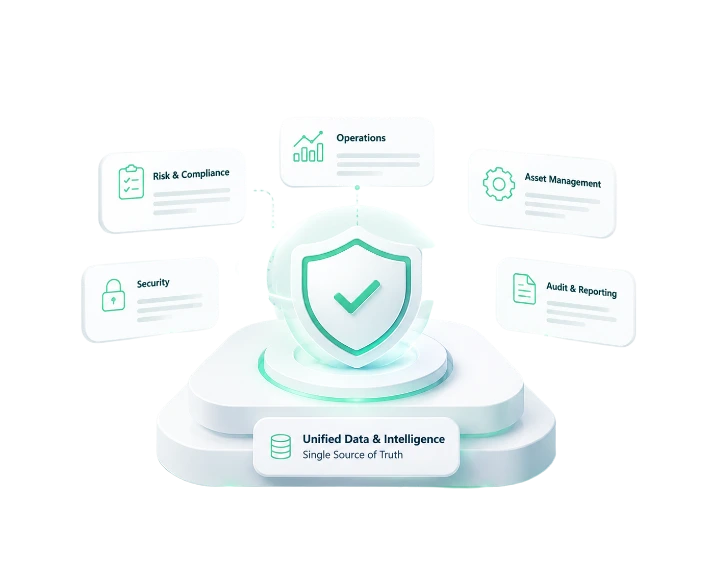
How information moves through Evalura
Each step builds on the connected record layer beneath it.
- 01
Capture
Risks, assets, incidents, obligations, and maintenance are captured as connected records.
- 02
Connect
A shared relationship layer links any record to any other - the connected graph.
- 03
Sense
On-device detection and weather rules add live operational signals.
- 04
Assess
Risk scoring, heatmaps, and compliance assurance turn signals into priorities.
- 05
Decide
Executive rollups and corrective actions move from a signal to the source record and the owner.
Built to connect, not just store
Evalura is organised as three layers that build on each other.
Systems of record
Risks, assets, incidents, obligations, controls, and maintenance - the enterprise record base.
Connected operational context
Relationships, corrective actions, locations, ownership, and workflows link records to reality.
Intelligence & decisions
Executive rollups, emerging trends, AI-assisted risk workflows, and operational signals drive decisions.
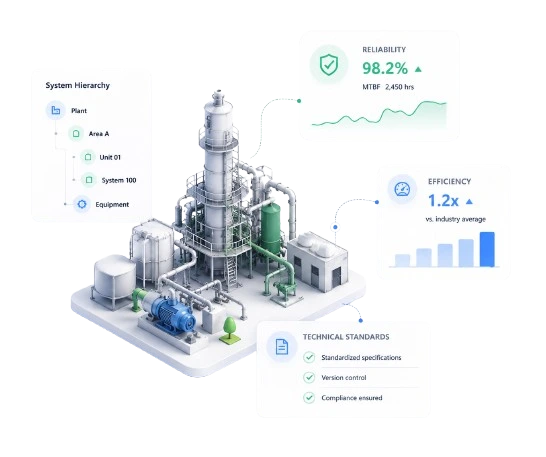
One relationship layer under every module
A shared relationship layer links any two records - a risk to the incident that realised it, an obligation to the control that satisfies it, an asset to its maintenance and exposure. Query every link for a record from one place.
- Link any record to any other record
- Corrective actions span modules
- Trace any signal back to its source record
Frequently asked questions
Do the modules connect automatically?
Records connect through the shared relationship layer as you link them, so context follows the record across modules without duplicating data.
Is Evalura fully autonomous or agentic today?
Today Evalura is connected operational intelligence with AI-assisted risk workflows, on-device detection, and rule engines. A fully agentic Operational Brain is on our roadmap, not presented as shipped.
Start a conversation
See Evalura connect your operational picture
Book a personalized demo and see how risk, compliance, incidents, assets, and maintenance connect into one operating system.